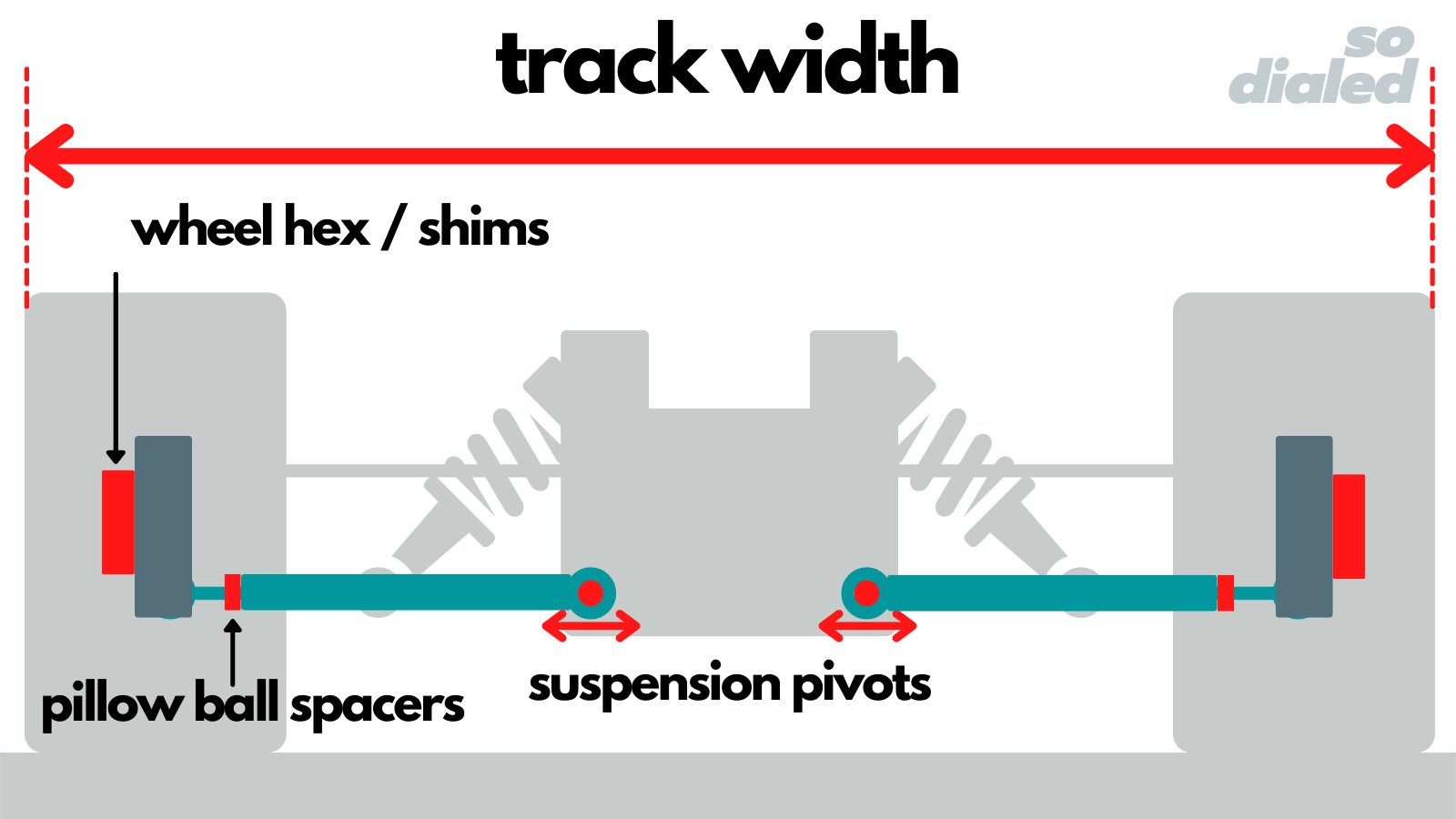
Suspension arms are what connect the car's chassis to the wheel hubs. There are usually two connections - on the lower side there is usually a suspension arm (aka wishbone) that provides the bulk of the strength, and on the upper side there is usually a tie-rod known as a camber link (because it is used to set camber), but some cars use an arm on top as well.
Most cars have solid arms that go all the way from the chassis to the hubs, while others have steel pivot balls (aka pillow balls - see below) at the end that are connected to the hub.
This article refers to the lower suspension arms.
Suspension arm length
Shorter arms
- Lower roll center
- More chassis roll
- Narrower track width
- Generally suited for low-grip tracks
Longer arms
- Higher roll center
- Less chassis roll
- Wider track width
- Generally suited for high-grip tracks
Using shorter arms requires softer shock settings.
Suspension arm stiffness
Some cars offer alternate suspension arms of different stiffnesses, and others allow inserts or stiffeners to be attached to the arm to change the stiffness. Here is how those changes will affect handling:
Front arms
Front softer arms / inserts
- More steering
- Less consistent handling over bumps
Front stiffer arms / inserts
- Less steering
- More consistent handling over bumps
Rear arms
Rear softer arms / inserts
- More lateral traction
- Less consistent line
Rear stiffer arms / inserts
- Less lateral traction
- More consistent line